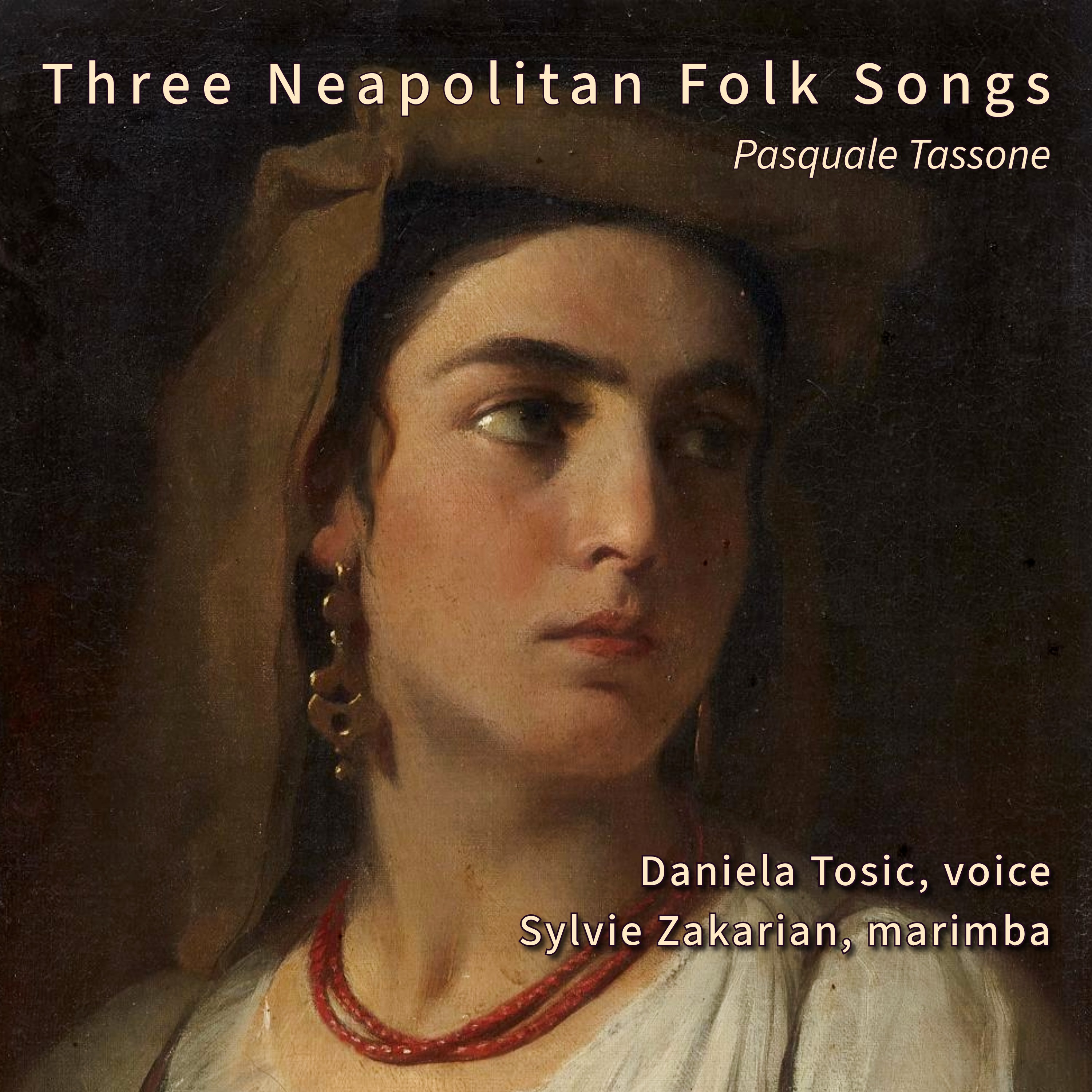
Pasquale Tassone’s Three Neapolitan Folk Songs were originally written for a soprano and violin, and later specially arranged for Sylvie Zakarian (marimba) and me. Mr. Tassone was drawn to the heart-felt message in each of the songs as well as their (melo)drama. While Italy has much folk music from its many regions, it is safe to say that when one thinks of Italian songs, these are invariably Neapolitan.
“Over the centuries, Naples has played a very important part in the history of music in Italy as well as the rest of the world. Its songs have become no less important in its history and famous singers from Caruso to Pavarotti have all performed and recorded some of the most popular ones. While Italy has much folk music from its many regions, it is safe to say that when one thinks of Italian songs (think "O Sole Mio", "Funiculì, Funiculá", "Santa Lucia", etc.), these are invariably Neapolitan. "Three Neapolitan Folk Songs" was first arranged for Soprano and Violin, and this version was specially created for Daniela Tosic, mezzo soprano and Sylvie Zakarian, marimbist. For this arrangement, I have strived to find songs that are not so familiar or often recorded. I was drawn to the heart-felt message in each of the songs as well as their (melo)drama.” - Pasquale Tassone
We recorded it at Q Division Studios in March 2026. It was engineered, mixed and mastered by Joel Edinberg. It's available for streaming on Bandcamp, Deezer, Qobuz, Amazon, Apple, Spotify, YouTube, and all the other platforms.
Pasquale Tassone studied at the Giuseppe Verdi Conservatory in Milan, has an honors diploma from the Chigiana Academy in Siena, Italy and a Ph D from Brandeis University. His Dzon (Concerto for Marimba and Strings) was performed in November 2015 by the AGBU London Chamber Orchestra, and the full orchestra version was premiered by the Reading Symphony Orchestra in December 2018. In January 2018, his Wings of Light for String Quartet was chosen by the Italian Center for Rare Diseases in Rome as an artistic contribution in the fight against rare diseases. Recently, renowned Italian pianist Alessandra Pompili, performed his music in Scotland and at the Vatican. The Lowell Chamber Orchestra premiered his Rhapsody for Flute and Strings in February of 2023 and will be featured on their next CD. His Trio Lirico was a winner in the Atlanta Contemporary Ensemble's call for scores and was performed in March of 2024. The Tampa Bay Symphony chose and performed his Rhapsody for Flute and Orchestra, the winning composition in its annual call-for-scores (2024-2025 season). More recently he has ventured into the world of musical theater working with librettist Alberta Handelman with whom he has collaborated on two musicals: A Musement Park and Tumbleweed. A Musement Park was presented at the New York Theater Festival in July 2025. A concert version of his opera, Seven Rabbits on a Pole, will be performed in October, 2026. More on Pasquale Tassone at migidamusica.org.
This recording was made possible in part by a generous faculty development grant from Winchester Community Music School.


Carmé
Fuori mura ci sta una picciotta,
Fra le spine s'é fatta una casa; sulle foglie riposa la note.
Una rosa piú bella non v'é.
Dormi, Carmé' Il piú bel della vita é dormir!
Sogna di me, su nel Cielo con te vo' salir!
Quando smette il lavoro in campagna, vien cantando una bella canzone;
essa dice che il cuore si lagna, ed io solo ne intendo il dolor!
Canta, Carmé' Com' é dolce il tuo canto sentir.
Canta per me. Che tu in Cielo mi fai salir!
Carmé
Out beyond the gray walls lives a maiden,
mid the rose bushes nestles her cottage, On some leaves she reclines at night.
No rose with her face can compare.
Slumber, Carmé! For to sleep is life’s dearest delight!
Return with me, I don’t want to leave you again.
When the labors of day are all over, she comes singing a beautiful song.
And she sings that her heart is aching; only I can share her sorrow.
Sing, Carmé! To thy song do I bend with delight.
Sing, oh for me. Up to heaven it takes me in flight!
Lu Carcerato P'ammore
Ve' che sorte m'é toccata! Star sepolto in questa fossa!
Son ridotto pelle ed ossa: ne morró dal dispiacer!
Per un'empia ingrata donna mi ritrovo qui all'o scuro
e m'aggrappo a questo muro per poterla un po' veder!
Non mi regge che la speme, in te fido, nera sorte!
Deh! mi schiudi queste porte, fa spuntar di gioia un di!
Se vedrò sì caro giorno quanti salti voglio fare!
Correró la mano a dare a co'lei che m'invaghi!
The Prisoner of Love
See what fate has me befallen! In this dungeon it has placed me!
Unto skin and bones reduced me; I will die so broken-hearted!
For an impious, ungrateful woman, I in darkness spend my days,
Desperate, I grasp the wall, for a glimpse of her to gain.
By my hopes am I supported, in you I place my trust, black fate!
Oh! Would you open these doors and let a day of joy appear!
If I should see such a day, how would I leap for joy!
I shall run to give my hand to the one I dearly love!
Nenella Vienete
Fanciulla, ma perché ti nieghi al mio desir? In mare in siem con me per che non vuoi venir? Quest' onde belle e chiare t'invitano a remare: fanciulla, vieni al mare, voglio vogar con te: si queta l'onda appare fanciulla, vieni a me.
Spezzarsi il cor non puó d'affanno e di dolor. Ah piú non dirmi: no, vieni mio dolce amor. Se dice una parola quell labbro di viola m'appaja e mi consola, felice io sen per te. T'affretta il tempo vola fanciulla, vieni a me.
Ma tu consenti al fin? Appaghi il mio desir! I'ho dunque a me vicin? Con me tu vuoi venir? Cessato é il mio dolore! Eppure son quattr' ore che a te, leggiadro fiore ch' io lo chiedevo a te. Parliamoci d’amore, fanciulla, vieni a me.
Fair Maiden Come with Me
Fair maiden tell me why, you ignore my desire? Why do you not accompany me into the sea? The beautiful clear waves invite us to be rowing: Fair maiden come to the sea, I wish to row with you: If a wave should appear, fair maiden, come with me.
You must not break my heart with longing and pain. Ah, please do not deny me, come my sweet love. If thy rose lips had told me one word it would have consoled me. While time flies, I am happy with you, fair maiden come with me.
But in the end do you agree? To satisfy my desire! To have me close to you, would you come with me? And still it has been four hours, in which my pain has ceased. That I have asked you, oh graceful flower, to speak to me of love.
Arrangements are based on songs from "Echoes of Naples (Thirty Neapolitan Songs)" by Mario Favilli, (Ed.), Boston: Oliver Ditson Company, 1909
Translations by Nathan Haskell Dole and Pasquale Tassone